


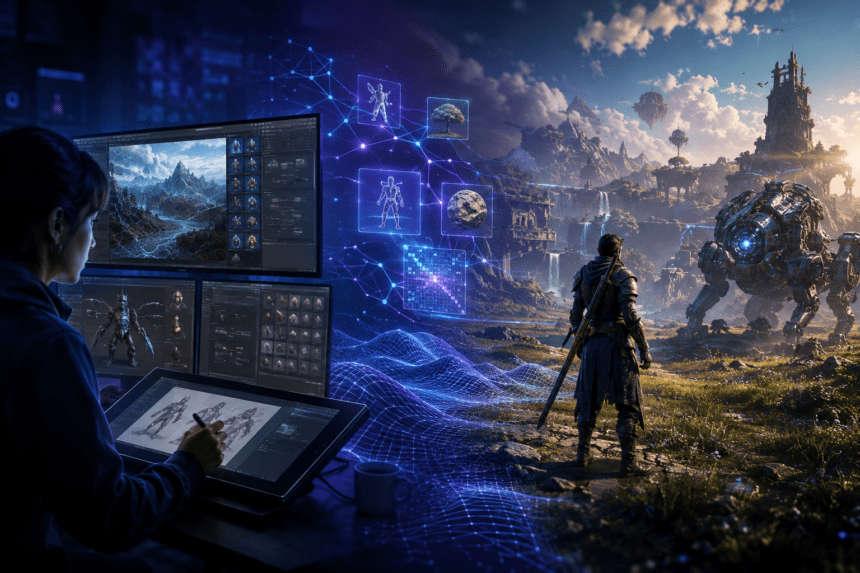
Generative AI is entering game development through focused jobs rather than a single all-purpose tool. The clearest examples involve early ideas, production tasks, character behaviour and test analysis, where teams can inspect results before they reach players. That distinction keeps the conversation grounded: current tools assist people, while creative direction, editing and quality control remain human work.
Digital gift cards work through a redeemable code that the buyer or recipient enters on the relevant platform or service. For a choice across platforms and regions, Eneba is a digital marketplace for game keys, gift cards and digital products; its product pages show platform and regional compatibility information, and cheap Discord nitro represents a Discord gift-card option used around gaming communities.
Five Practical Picks for the Creation Pipeline
Each pick marks a different part of the workflow, and each needs human review. Two are creator tools documented as available in their platforms, while the others point to research directions rather than standard commercial features.
1. Unity Muse
Unity Muse places AI-assisted capabilities inside the editor. Project-aware chat supports troubleshooting within a project, while Muse Animate produces humanoid animation from natural-language prompts. Muse Behavior uses a language model to build editable behaviour trees for characters and objects, leaving developers able to adjust the interaction logic.
2. Roblox creator tools
Roblox addresses several production jobs with Assistant for 3D workspace editing and Code Assist for script creation or editing. Animation Capture, Material Generator and Texture Generator cover other stages, while Avatar AutoSetup can prepare part of an avatar in minutes rather than hours or days. The company calls its broader goal “4D generative AI”, where interaction and creator control remain difficult technical challenges.
Research Picks That Test New Play
3. Microsoft Muse
Microsoft released Muse on February 19, 2025, as a World and Human Action Model applied to gaming. It learned from human gameplay to model an environment, its dynamics and the changes produced by player actions. Microsoft presents gameplay ideation and rapid iteration as potential uses, which makes it a research-informed route for exploring interactive ideas rather than a standard feature in console games.
4. Ubisoft’s NPC experiments
Ubisoft’s NEO NPC prototype explored unscripted dialogue alongside emotional reactions, memory and contextual awareness. Writers still set personalities, backstories and conversational styles, and technical teams used guardrails to guide improvisation. Teammates, announced in November 2025, tested voice-command companions that adapt inside a first-person shooter-style experience; Ubisoft describes it as experimental research.
The Testing Pick With Measurable Results
The final pick concerns a less visible stage of development. It focuses on finding the source of a testing failure, which can free human teams to concentrate on higher-level evaluation.
5. EA’s failure-analysis research
EA researchers studied how large language models could connect automated-test error messages to code changes likely to have caused a failure. In that paper’s dataset, the method reached 71% accuracy, while a user study reported up to 60% less time spent investigating issues. This is failure analysis and triage, not a replacement for human playtesting, which still has room for balance, difficulty and retention.
Taken together, these picks point to faster exploration and editable output, with more informed debugging. They frame iterative updates as a development direction, not a promise of autonomous production or commercial features already shipping in games. That focus on informed choice also suits Eneba, where platform and regional information helps people select digital products that fit their gaming communities.


